Ajanta and Ellora Caves Tour: Kailasa, Murals & Best Time
An Ajanta and Ellora caves tour takes at least two days from Aurangabad: Ajanta for its ancient Buddhist murals and Ellora for the vast Kailasa Temple carved from one rock. October to March is the most comfortable season, and in November expect roughly 29°C by day and 16°C at night. Ellora lies about 30 km from the city, Ajanta about 100 km or more.
Ajanta and Ellora caves tour at a glance
Why take an Ajanta and Ellora caves tour
Few places in the world show so much human devotion in stone. At Ajanta, monks carved prayer halls and monasteries into a horseshoe-shaped gorge and decorated them with paintings that still glow after well over a thousand years. At Ellora, three faiths worked side by side along one escarpment, creating monasteries, temples and shrines that reveal how tolerant and creative medieval India could be. Together they are the highlight of Maharashtra and a natural add-on to a trip through Mumbai or central India. Our Ajanta and Ellora Caves page shows how we build them into private itineraries.
History of the caves
Ajanta’s earliest caves are generally dated to around the 2nd century BCE, with a second burst of work in the 5th century CE under the Vakataka dynasty. The site was later abandoned and the forest reclaimed it, until a British officer on a hunting party stumbled on it in 1819. Ellora is broadly later, with work spanning roughly the 6th to 10th centuries. Its Buddhist caves came first, followed by Hindu temples under the Rashtrakuta rulers and Jain caves after. The great Kailasa Temple is usually attributed to the 8th century. Treat all dates as approximate, as scholars still debate them.
Best time to visit Ajanta and Ellora: month by month
Figures are rounded, approximate averages for Aurangabad and vary by year.
| Month | Avg high | Avg low | Conditions |
|---|---|---|---|
| January | 29°C | 14°C | Cool, dry, clear |
| February | 32°C | 16°C | Warm days, pleasant |
| March | 36°C | 20°C | Heating up |
| April | 39°C | 24°C | Hot, go early |
| May | 40°C | 26°C | Very hot |
| June | 34°C | 24°C | Pre-monsoon showers |
| July | 29°C | 23°C | Monsoon, green hills |
| August | 28°C | 22°C | Wet, waterfalls |
| September | 29°C | 22°C | Rain easing |
| October | 31°C | 20°C | Post-monsoon, fresh |
| November | 29°C | 16°C | Comfortable, clear |
| December | 28°C | 14°C | Cool mornings, dry |
October to March gives the best walking weather. The monsoon is beautiful but slippery, and April to May can be punishing around midday.
Weather and packing for November
November is one of the best months, with sunny, mostly dry days near 29°C and cooler evenings around 16°C. Pack:
- Light cotton clothing, a sun hat and sunscreen, since the caves involve open walking.
- Comfortable shoes with grip for stairs and uneven rock, plus socks for temples where shoes come off.
- A water bottle, a small torch for dim interiors and a light layer for early mornings.
What to see at Ajanta and Ellora
Ajanta Caves. Roughly 30 caves cut into a crescent of basalt above the Waghora river. Cave 1 and Cave 2 hold the best-known paintings, including the celebrated Bodhisattva figures, while Caves 16 and 17 show stories of the Buddha’s earlier lives. Lighting inside is low and flash photography is restricted to protect the pigments.
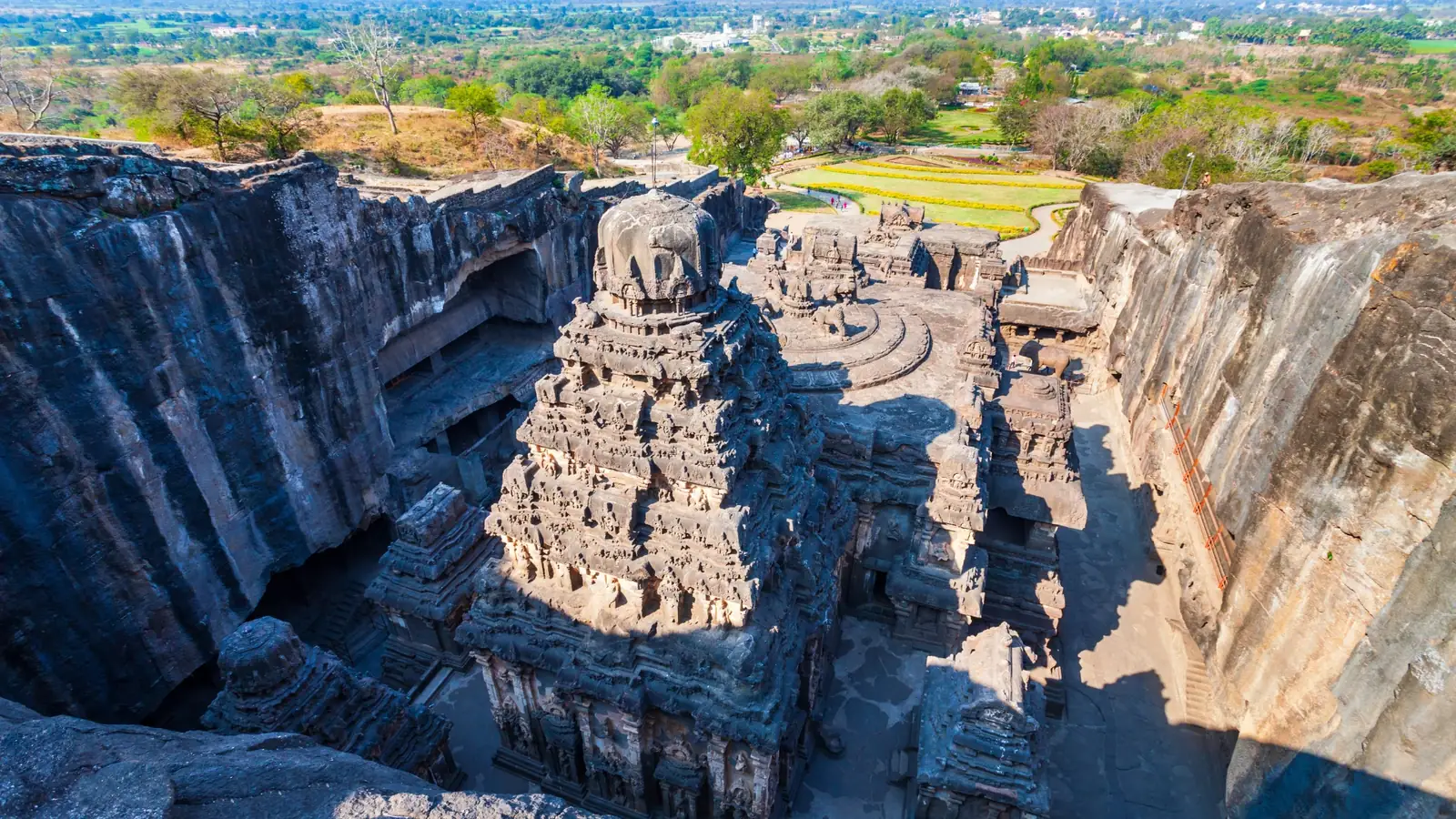
Kailasa Temple, Ellora (Cave 16). A full temple complex carved top-down from a single rock, modelled on Mount Kailash. Walk the courtyard, climb the side stairs for the overview and study the carved elephants and mythological panels.
Ellora’s other caves. Caves 1 to 12 are Buddhist, including the impressive Cave 10 prayer hall, Caves 13 to 29 are Hindu, and Caves 30 to 34 are Jain, with fine detail in the Indra Sabha. Together they form one of the world’s great multi-faith sites.
Around Aurangabad. Add Daulatabad Fort, Bibi Ka Maqbara (often called the Taj of the Deccan) and the nearby Grishneshwar temple. For another ancient Buddhist site, read our Buddhist trail guide.
Suggested 3-day itinerary
Day 1. Arrive in Aurangabad, visit Bibi Ka Maqbara and Daulatabad Fort, and rest.
Day 2. Early start for Ajanta, with time for the main painted caves and the viewpoint across the gorge, then drive back.
Day 3. Spend the morning at Ellora, focusing on Kailasa and a few Buddhist and Jain caves, then stop at Grishneshwar before departing.
People, culture and food
Aurangabad sits in the Marathwada region, where Marathi culture mixes with a Mughal and Deccan past. Local food includes naan khalia, a rich mutton curry linked to the city, along with Maharashtrian staples such as misal pav, puran poli and thalipeeth. Silk and Himroo weaving and Paithani sarees are regional crafts worth browsing. Dress modestly at temples, remove shoes where asked and follow site rules on touching or photographing carvings.
How to reach and plan with Tour En Inde
Aurangabad has its own airport with flights from Mumbai and Delhi, plus a railway station on the main line, and most visitors base themselves in the city. Ellora is roughly 30 km away and Ajanta roughly 100 to 110 km, so a private car with a driver is the easiest option. From Mumbai, you can also continue to Mumbai or break the route at Lonavala. Our Buddha Pathway tour and Journey Through the Heart of India pair well with the caves.
Practical tips for visitors
- Check closing days before you go: Ajanta is usually closed on Mondays and Ellora on Tuesdays.
- Start early to beat the heat and the tour buses, especially at Ajanta.
- Hire a licensed guide, as the stories behind the murals and carvings make the visit.
Ajanta and Ellora caves tour: FAQs
How many days do you need for an Ajanta and Ellora caves tour?
Two full days is the comfortable minimum: one for Ajanta, which is a long drive from Aurangabad, and one for Ellora with Daulatabad Fort or Bibi Ka Maqbara. Three days adds a slower pace and Grishneshwar temple.
What is the best time to visit the Ajanta and Ellora caves?
October to March is generally the most comfortable, with cooler days. The monsoon from July to September turns the hills green and the waterfalls near Ellora flow, but rain can make walking slippery. April and May are very hot.
Which is better, Ajanta or Ellora?
They are different. Ajanta is a Buddhist site famous for ancient wall paintings, while Ellora blends Buddhist, Hindu and Jain monuments and is known for the monolithic Kailasa Temple. Most travellers see both.
Which day are Ajanta and Ellora closed?
Ajanta is usually closed on Mondays and Ellora on Tuesdays, but days and timings can change, so confirm with the Archaeological Survey of India or your operator before travelling.
How far are the caves from Aurangabad?
Ellora is roughly 30 km from Aurangabad (Chhatrapati Sambhajinagar), about an hour by road. Ajanta is roughly 100 to 110 km away, a drive of around two to three hours each way.
Can Tour En Inde arrange an Ajanta and Ellora caves tour?
Yes. We arrange private cars, hotels, guides and entry logistics, and can add the caves to a Mumbai, Buddhist circuit or Heart of India itinerary.
Plan your Ajanta and Ellora trip with us
Tell us your dates and interests, and our specialists will shape an Ajanta and Ellora caves tour around your pace.